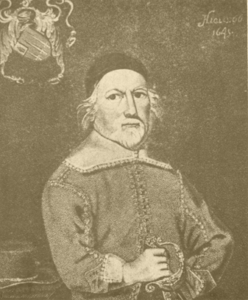
Sir Edward, 1st Baronet Hales
Hales Place Chapel
The chapel is a unique Grade 2 listed landmark on Tenterden Drive in Canterbury. Although it is frequently referred to as a former dovecote or a Jesuit mortuary chapel, it dates to the eighteenth century as an elite landscape feature. Understanding its true evolution from an iconic Georgian garden viewpoint to a place of worship demonstrates its significance to the history of St Stephen’s and to Canterbury.
The Belvedere
The building was originally a secular garden building integrated into the sprawling grounds of the Hales Place estate. It was built in the mid to late eighteenth century and the building was probably designed to celebrate the elevated estate geography. In 1776, the historian Charles Seymour published A New Topographical, Historical and Commercial Survey of Kent. He suggested that the palatial Hales Place Mansion, situated on what is now The Terrace, was ‘more fit for the residence of a monarch than for a simple country gentleman.’ Seymour explicitly described the chapel building as ‘a belvedere’, an architectural lookout intended to offer a sweeping view over the city and the Cathedral. Local tithe maps recorded the building as a dovecote although this is unlikely to have been the case.
The Jesuit Era: The Mortuary Chapel
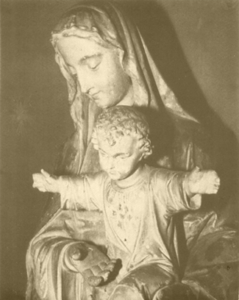
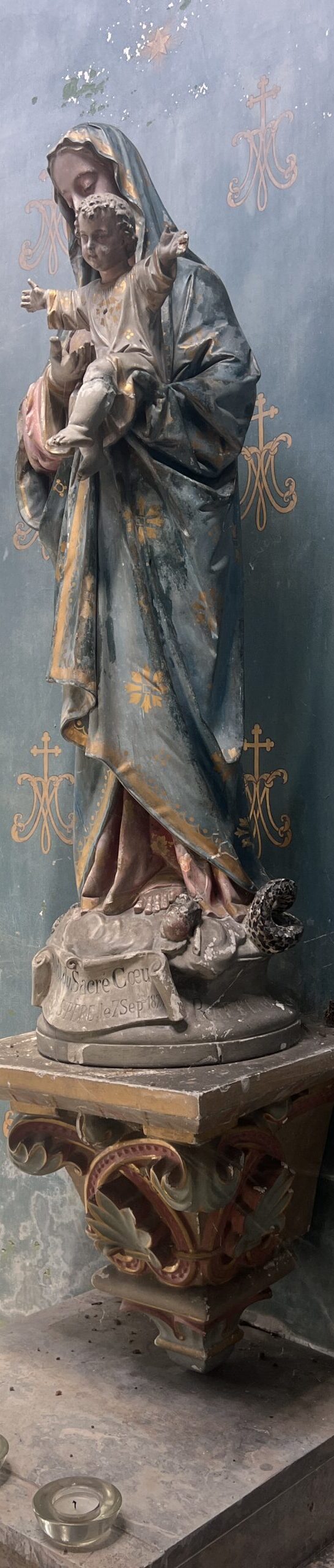
Madonna and child, statue in the Hales Place Chapel
When Mary Barbara Felicity Hales had bankrupted the estate with her extension and beautification of the Roman Catholic chapel next to the mansion and the building of a Benedictine Monastery that was never completed, she was forced to sell to the French Jesuits who were fleeing the secularisation laws in in Lyons. The Jesuits extended the mansion, with classrooms and dormitories in two new wings, and established St Mary’s College in 1884. Miss Hales’ ‘petite chapelle rustique’ became the mortuary chapel to serve the newly established Jesuit cemetery next to the building. A striking marble altar was added and the chapel area became the final resting place for students and members of the order at the college and later the seminary that opened in 1901. In 1924, the Jesuits returned to France and the estate was put up for sale but could not find a buyer.
The Twentieth Century to 2026
In 1928, the mansion was sold to R. A. Dagnell for demolition and salvage. The walls were demolished with gelignite, and the best bricks and internal fittings were sold at auction. The chapel survived the destruction, and Mr Dagnell gave it to St Thomas’ Catholic Church. The bodies of the Fifth Baronet, the Dowager Lady Frances Hales and Mary Barbara Felicity Hales were exhumed from the crypt of the main chapel at the mansion and re-buried at the chapel.
In the 1970s, local people were concerned about the building which was the victim of vandalism and neglect. A group of volunteers began a campaign to save the chapel from further decay and in 1984, Canterbury City Council became the owner of the building. It was completely restored and the group, the original Friends of Hales Place Chapel, worked with the City Council to make it available for visits and ecumenical worship. The group dissolved in the 1990s and so we come to 2026 when the City Council designated the chapel as a community asset following a request from St Stephen’s Residents’ Association. The Council then awarded a grant to carry out urgent weatherproofing and ground stabilisation. A new group has now launched a revitalised campaign to establish a new Friends of Hales Place Chapel with plans to restore the interior and open the chapel so that everyone can enjoy the beauty and peace that this little building engenders to all those who visit it.